

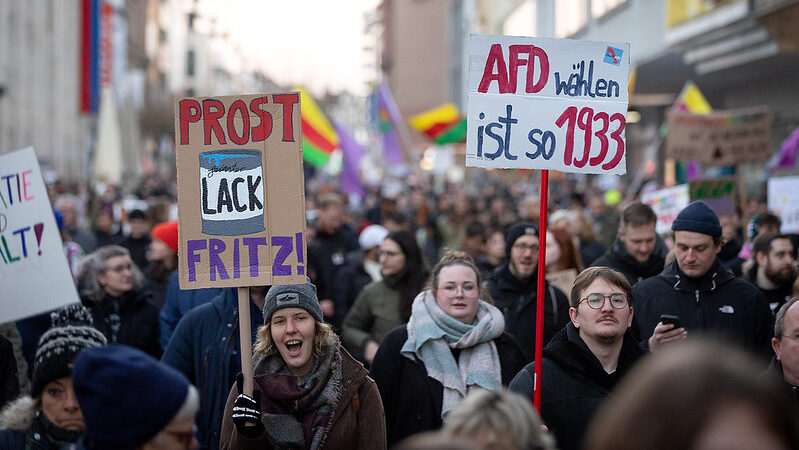
Days before Germany’s federal election, polls predict a victory for the right-wing Christian Democratic Union (CDU) at 30%, with the far-right Alternative for Germany (AfD) following at around 20%—double its support from 2021. Meanwhile, the centrist parties that formed the recently collapsed “traffic-light” coalition—the Social Democratic Party (SPD), the Greens, and the Free Democratic Party (FDP)—have seen their support plummet. At best, they can hope to be invited into a coalition after the results come in.
Unsurprisingly, the CDU is already exploring options, including with the Greens, after assuring it would not seek a majority with the AfD. The SPD and FDP could also factor into these calculations, depending on the final numbers. While this might seem unusual given the supposed ideological differences between these parties, a closer look at their core policies points otherwise. Virtually all mainstream parties in Germany have embraced austerity measures and deficit management, sidelining working-class concerns over rising living costs and labor rights.
Read more: 100,000 protest in Brussels against Arizona coalition’s austerity and attacks on rights
This convergence also reflects similarities in the composition of their voter bases. As Jacobin Magazine recently reported, the CDU and Greens share a more similar electorate than expected—attracting members of the highly educated professional managerial class and entrepreneurs, with blue-collar workers making up the smallest share. Consequently, their platforms align in areas such as creating business-friendly policies and maintaining strong ties with other Global North countries. Additionally, the Greens, who once took pride in more progressive stances, have taken a notably conservative turn, particularly on militarization and NATO integration, with Green Foreign Minister Annalena Baerbock being responsible for some of the most aggressive statements regarding Israel’s genocide in Gaza and the war in Ukraine.
Another major and near-universal shift to the right has been on immigration, where the SPD and Greens are now seen competing with the CDU over who will implement the toughest deportation policies. This shift follows a narrative pushed by the AfD, which proposes that fear of illegal immigration and liberal asylum policies is driving voter decisions. However, recent surveys show otherwise: German voters seem to be more preoccupied with peace, with immigration ranking much lower—well behind the economy and social justice. These are precisely the topics mainstream parties and the AfD prefer to avoid, likely because they remain committed to the same failed approach of budgetary constraints.
Read more: Springtime for militarization, winter for social rights in Germany
That addressing real working-class concerns resonates with voters is evident from the recent improvement of ranking of the progressive party Die Linke. Just weeks ago, the party was struggling to meet the parliamentary threshold. Since then—aided, to be fair, by CDU leader Friedrich Merz’s risky move of accepting AfD votes in the Bundestag—Die Linke has climbed to approximately 7%, running on a platform centered on housing, cost of living, and tax justice. Some analysts argue that it is the only party presenting a concrete plan for funding its proposed policies, countering the liberal presumption that even moderate progressive policies come at the expense of economic stability.
Despite this glimpse of hope, Sunday’s election results are likely to be grim. Even if the AfD is kept out of the cabinet this year, the continued push by right-wing and liberal parties for failed policies will only embolden the far-right further. To counter this, leftist forces must begin mobilizing immediately—offering a vision radically different from that of the AfD.



