

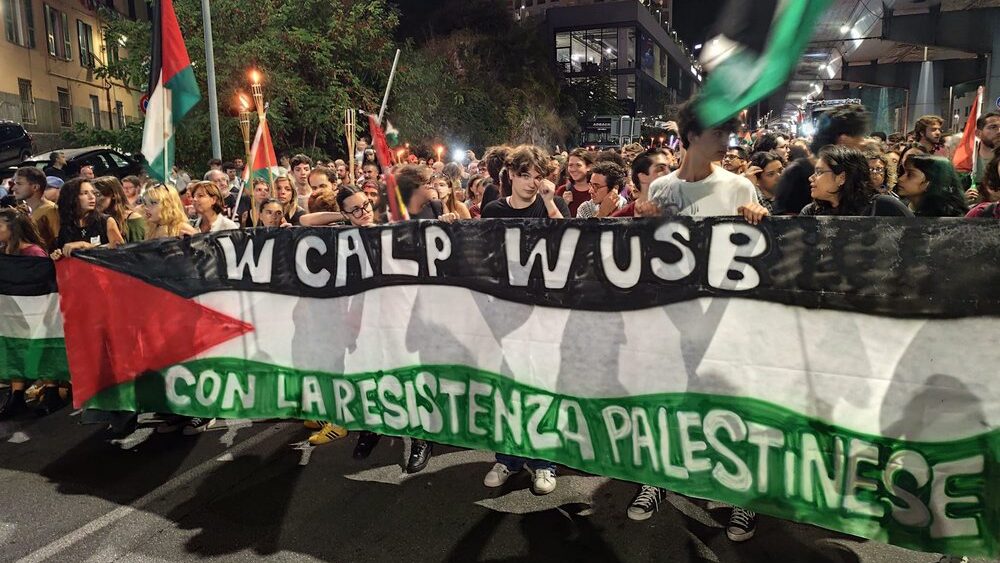
“If for only 20 minutes we lose contact with the ships and with our comrades, we will block the whole of Europe,” a dockworker in Genoa declared before tens of thousands of people gathered to send off the Global Sumud Flotilla at the end of August. “[We will do it] together with our union USB [Unione Sindacale di Base], together with all the dockworkers, with the entire city of Genoa. From this region, 13,000–14,000 containers leave for Israel every year: not one single nail will get out of our port!”
The announcement sent ripples across the region, which has contributed dozens of crew members to the largest attempt yet to break Israel’s illegal blockade of Gaza by sea.
Read more: Global Sumud Flotilla ready to break Israel’s blockade of Gaza
The Global Sumud Flotilla is expected to reach Gaza by mid-September, carrying activists, health workers, trade unionists, and ordinary people refusing to accept their governments’ complicity in war crimes. On board are members of left parties from France, Ireland, Spain, Portugal, and Greece, and Members of the European Parliament. Sailing in line with international law and endorsed by UN Special Rapporteur Francesca Albanese, participants nevertheless anticipate an assault by Israeli forces. Before the flotilla set sail, Israeli Minister Itamar Ben-Gvir threatened to classify the crew as terrorists, subjecting them to imprisonment in high-security prisons – for attempting to deliver food and medicine to Gaza.
Among participants are members of Genoa’s Autonomous Collective of Port Workers (Collettivo Autonomo dei Lavoratori Portuali, CALP). In the period before the launch, together with the group Music for Peace, they organized a mass collection of food and supplies for Gaza, gathering tons of donations in just days.
A legacy of struggle against the arms trade
CALP’s efforts build on a long tradition of local transport and logistics workers resisting the arms trade. In the past, they blocked deliveries to Saudi Arabia and other states engaged in armed conflicts. Since Israel began its genocide in Gaza, Genoa’s dockworkers have strengthened cooperation with comrades in Morocco, France, Greece, and Türkiye to disrupt shipments destined for Israeli military use.
Read more: Italian city says no to warships and weapons for Israel
“To those surprised by our message of total blockade, we respond clearly: we dockworkers have always fought against wars with union tools and methods of struggle,” CALP wrote on social media. “Our tradition is to fight fascism in Italy relentlessly. Our predecessors organized a large expedition to help the people of Vietnam, opposed the Greek colonels, and resisted the coup in Chile.”
“We do it because we are human beings, and we will continue until the end,” the collective added. “We do it because we refuse to be cogs in these wars or accomplices to them. Weapons destined to strike around the world pass through our ports, produced, sold, and shipped by European governments. We cannot turn a blind eye.”
Building concrete solidarity from the workplace
Connections with other workers’ organizations, along with coordination with other Italian unions, will be essential if Israeli forces intercept the flotilla as they did with the ships Handala and Madleen earlier this year. There’s a high degree of understanding among the workers, and assemblies are already being held in other port cities like Trieste and Livorno, Giovanni Ceraolo of USB’s port chapter told local media.
Read more: Militarization in Italy: from the war economy to the battle of ideas
CALP’s campaign has drawn support from a wide range of sectors. Education workers and students – including the university-level group Collettivi Autoorganizzati Universitari (CAU) – along with public services such as firefighters and regional USB branches, issued statements pledging solidarity if the flotilla is attacked. “While Israel threatens to treat the activists of the Global Sumud Flotilla, including our port delegates from Genoa, as terrorists, we respond with the power of the streets, with rejection of militarization and the war economy, and with solidarity that translates into concrete action,” USB Sicily wrote.
For many activists, the dockworkers’ initiative shows how Palestine solidarity can expand by rooting itself in workplaces that directly influence European governments’ ability to sustain armed conflicts and war crimes. As José Nivoi, a CALP and USB member who joined the flotilla, said before departure: “The mobilization of port workers has led to a real boycott starting from the workplace. This is what makes active international solidarity real and concrete today. We’re moving from theory to practice, beginning at the workplace.”



