

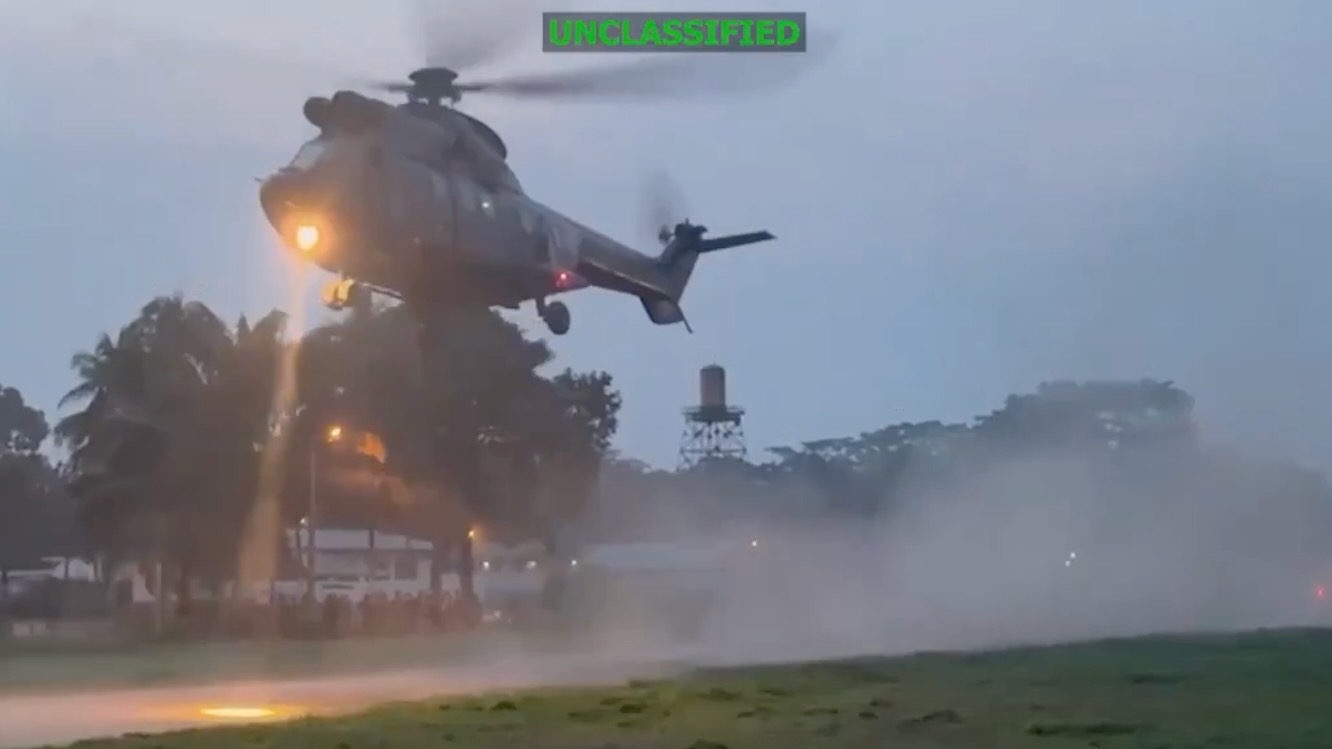
On March 3, the US Southern Command announced on X that US military forces had participated in actions alongside Ecuadorian security forces: “Ecuadorian and US military forces launched operations against Designated Terrorist Organizations in Ecuador. The operations are a powerful example of the commitment of partners in Latin America and the Caribbean to combat the scourge of narco-terrorism. Together, we are taking decisive action to confront narco-terrorists who have long inflicted terror, violence, and corruption on citizens throughout the hemisphere.”
In addition, the commander general of the Southern Command, Francis L. Donovan, stated: “We commend the men and women of the Ecuadorian armed forces for their unwavering commitment to this fight, demonstrating courage and resolve through continued actions against narco-terrorists in their country.”
For his part, Ecuadorian President Daniel Noboa, a right-wing politician, wrote in a statement: “In March, we will carry out joint operations with our allies in the region, including the United States. The safety of Ecuadorians is our priority, and we will fight to achieve peace in every corner of the country.”
According to the US Embassy in Ecuador, the initial operation, carried out on March 3, dismantled an international drug trafficking network linked to the criminal group “Los Lobos” that operates in the provinces of Guayas, El Oro, and Loja. The operation led to the arrest of a key leader of the criminal group and the seizure of an undetermined amount of cocaine and more than USD 800,000.
“The investigation also revealed collaboration between Los Lobos and an Albanian drug trafficking organization, whose members traveled to Ecuador to negotiate and secure large-scale drug shipments. Once in Europe, the cocaine entered an extensive logistics network and was quickly distributed across several countries,” said the US Embassy in Ecuador.
That same day, Interior Minister John Reimberg reported that another operation had been carried out against the Albanian Mafia in the cities of Guayaquil, Machala, and Quito, where nearly USD 1 million in vehicles, jewelry, and weapons were seized. In addition to Ecuadorian security forces, Europol and the DEA participated in the operation, and coordinated actions were carried out in Belgium and the Netherlands.
However, US and Ecuadorian authorities have not confirmed whether US soldiers participated in joint military operations on Ecuadorian territory. A video shown by the Southern Command depicts a helicopter with soldiers, although it is unclear whether the images were taken in Ecuador or are merely for reference.
A controversial decision
At the end of 2025, Daniel Noboa’s right-wing government suffered a shocking electoral defeat in the November referendum. Among the questions asked was whether foreign military bases should be allowed on Ecuadorian territory, thereby reforming the constitution that prohibits them.
However, Noboa’s government, as it has done on other occasions, has decided to find new ways to pursue its neoliberal project in the political and economic spheres, even against the majority position of the Ecuadorian people, which is why several critics of the government have labeled it “authoritarian” and “undemocratic.”
And while it is true that no foreign military bases have been established, the possible deployment of foreign military forces, in this case US forces, has not been consulted with the Ecuadorian people or Congress. On the contrary, the decision was made within the Carondelet Palace.
In fact, on March 2, one day before the announcement of joint military actions, President Noboa and his team met with the commander general of the Southern Command, Donovan, at the Presidential Palace in Quito. The senior US military official said: “Ecuador is one of the United States’ strongest partners in disrupting and dismantling designated terrorist organizations in the region”. Also present was Mark S. Schafer, head of Special Operations Command South. After the meeting, Noboa stated that “the next phase of the fight against organized crime” would begin.
However, it is not yet clear what these joint actions announced by both parties will consist of. Clearly, collaboration in the transfer of information and intelligence has already taken place in the past, in accordance with agreements signed several years ago, but the announcement by Washington and Quito seems to herald a much deeper and more active form of collaboration.



