

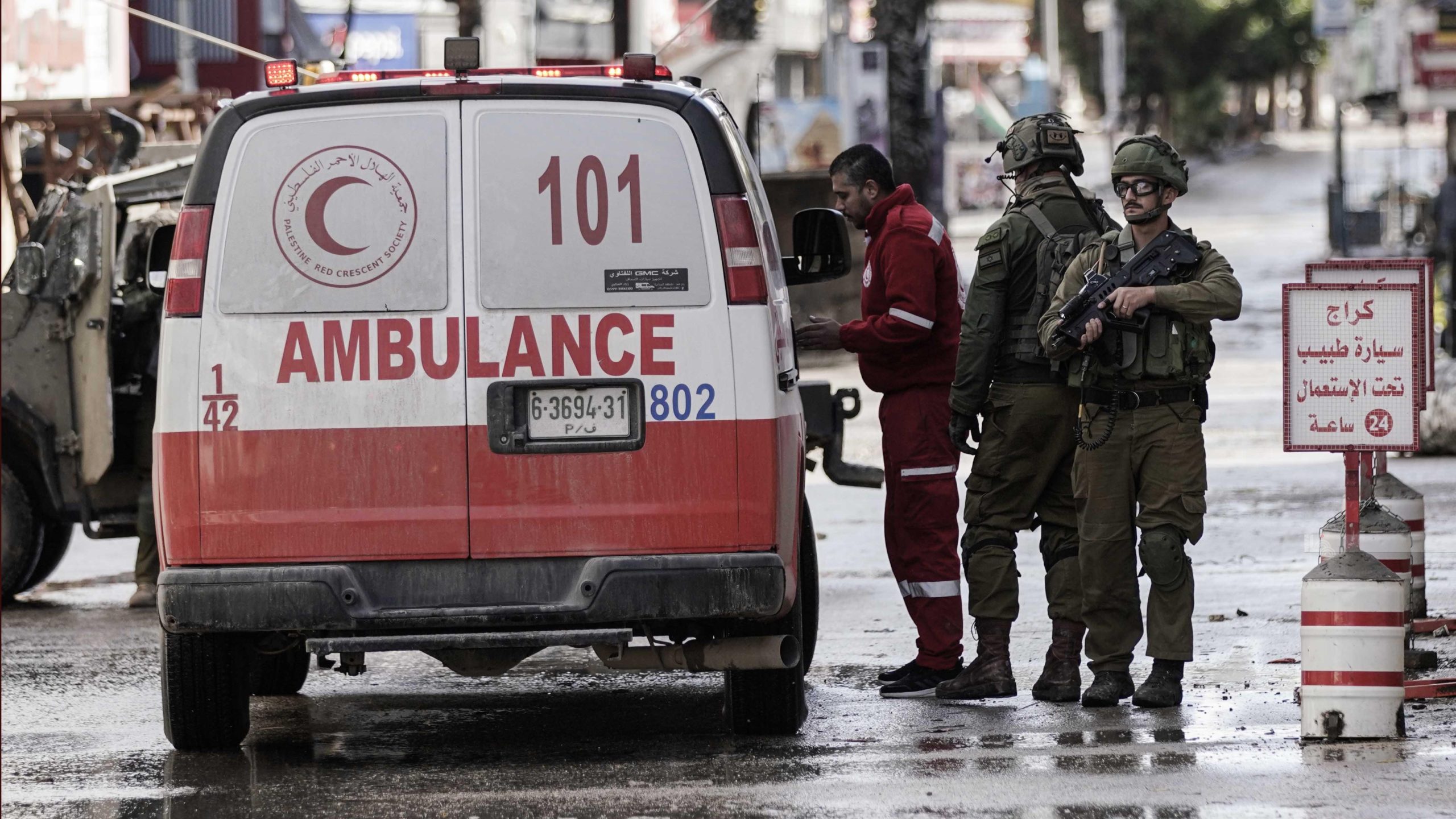
Hospitals in Gaza are still to begin recuperating from 15 months of relentless attacks when Israeli forces, with support from the Palestinian Authority, launched assaults on healthcare institutions in Jenin. Over the past few days, at least three hospitals in the West Bank have been targeted, and nurses, doctors, and administrative staff were injured. Armed forces blocked movement to and from hospitals, leaving patients and displaced individuals sheltering there in a state of fear and uncertainty, picturing the scenarios previously endured in Gaza.
Meanwhile, many health workers from the Gaza Strip remain imprisoned by Israel despite the ceasefire. Among them are physicians Ahmed Muhanna and Hussam Abu Safiya, who were taken from Al-Awda Hospital and Kamal Adwan Hospital, respectively. Dr. Abu Safiya, abducted during the December 2024 raid on Kamal Adwan, is still being denied access to legal counsel, the Al-Mezan Center for Human Rights warned on January 22. This restriction is expected to continue until at least early February.
The absence of hundreds of health workers—imprisoned, tortured or killed by Israel—is deeply felt in Gaza. According to the Ministry of Health, there are no fully functional hospitals in the region, and UNICEF estimates that less than half of the 36 hospitals are partially operational. Surviving health workers have been working tirelessly for over a year and are in desperate need of rest, even as the full scope of the health impact of the genocide is only beginning to be assessed.
Read more: Remember the Palestinian doctors killed by Israel
Current evaluations indicate that approximately 20% of Gaza’s population now lives with permanent disabilities requiring long-term care and rehabilitation. Thousands of children have lost one or more limbs since October 2023, while physiotherapy services, critical for their recovery, have been decimated during the same period.
Doctors recount operating on children “wounded by tiny fragments of shrapnel, which often leave barely visible entry points but cause extensive internal damage, and appear to be intentionally designed to increase the number of casualties.” Many of these children have been waiting for medical evacuation for months, with their requests consistently blocked by Israel. Although the World Health Organization (WHO) reported some medical evacuations just ahead of the ceasefire, the numbers fall drastically short of meeting the actual needs.
While UN agencies view the first phase of the ceasefire as a chance to address the health needs exacerbated by the genocide—including administering over 400,000 overdue vaccinations to young children—most health challenges will take much longer to resolve. Among these are the emotional trauma endured by children and families who have faced forced separation, hunger, and the harrowing conditions surrounding pregnancy and childbirth during this period.
Al-Mezan’s analysis of women’s reproductive health during the genocide highlights once again the dire conditions under which Palestinians were forced to bear and deliver children. Testimonies from midwives and physicians reveal that many childbirths took place under the light of mobile phone flashlights due to electricity cuts, with external wound sutures used for surgical incisions due to shortages, causing more pain.
During this time, Gaza hospitals saw a significant drop in deliveries at facilities under siege and attack by Israeli forces, contrasted by a surge in deliveries at hospitals that were on the route of forcibly displaced people, leading to different kinds of uncertainty. Overall, as described in the Al-Mezan report, the stress of displacement and hunger dealt a severe blow to maternal and newborn health. Hundreds of babies were born underweight as mothers, weakened by malnutrition, lost the ability to breastfeed and were forced to rely on formula, which was nearly impossible to find.
Read more: Israeli destruction of Gaza’s healthcare is a blueprint for future imperialist wars
The effects of early malnutrition and trauma are certain to leave lasting scars on those who survived to witness the first phase of the ceasefire. Adding to these challenges are the lingering physical dangers in Gaza. The UN estimates it will take approximately 10 years and half a billion US dollars to clear the unexploded ordnance scattered across the Strip. These looming hazards underscore that a true end to Israeli violence in Gaza remains far from reality, a warning echoed by the Health Advisory Council of Jewish Voice for Peace and numerous other networks.
“We honor our heroic colleagues in Gaza, who have selflessly served their communities under unimaginable conditions. We hope the ceasefire allows them a moment to breathe, rest, and recover,” the People’s Health Movement (PHM) said in its statement. “However, a ceasefire alone is not enough […] Justice must be pursued and the ceasefire should make place for peace in Gaza as well as the West Bank.”
“Ultimately, lasting peace in Palestine is unattainable under the systems of apartheid and occupation. They must be dismantled for peace to take root in Palestine,” PHM said.
People’s Health Dispatch is a fortnightly bulletin published by the People’s Health Movement and Peoples Dispatch. For more articles and subscriptions to People’s Health Dispatch, click here.



