

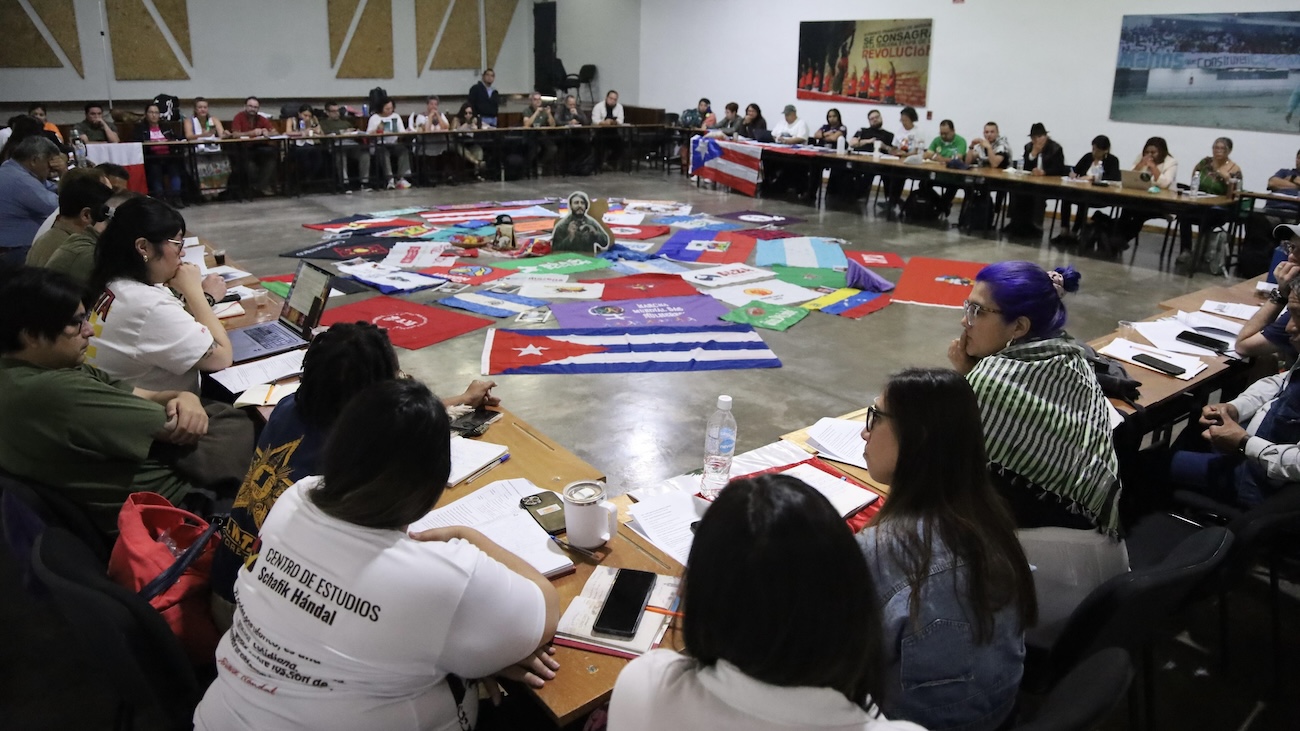
The ALBA Movimientos political coordination meeting took place in Caracas, Venezuela from July 22-24. More than 60 delegates from different countries in Latin America and the Caribbean participated in the meeting held at the Robinsoniana School of the Francisco de Miranda Front, a political training center rooted in the Bolivarian tradition.
During the three days, delegates participated in an intense agenda of debates focused on the current challenges facing the peoples of the region. The meeting began with a panel dedicated to analyzing the systemic crisis of global capitalism, under the umbrella of economic transition and anti-patriarchal, anti-colonial, and anti-imperialist struggles. The panel addressed the profound transformations taking place on the international stage and how these are impacting the daily lives of the popular majority. This was followed by a shared analysis of the regional situation, with the aim of building a common ground for agreement and identifying the current political moment in Latin American countries, in a context of sustained advance of the far right.
One of the central focuses of the debates revolved around the ideological dispute, understood not as an abstract confrontation of ideas, but as a conflict between projects of power. “Any analysis of the ideological dispute must recognize that there is a conflict between the ideas of liberation and the ideas of domination. There is a blurring of ideologies in their traditional sense, which allows anything that resembles social justice to be labeled communism, and any criticism of capitalism to be confused with fascism,” the delegates said during the summary.
This phenomenon of discursive distortion, which in many cases is sustained by fundamentalist or ultra-conservative narratives, was discussed in relation to the growth of evangelism as an expression of a new religiously based political fundamentalism. Faced with this scenario, it was reaffirmed that the battle of ideas cannot be limited to arguments, but must be part of the struggle for real power, for control of the economy, and for the capacity to implement social projects. Along these lines, Manuel Bertoldi, a member of the Political Coordination of ALBA Movimientos, recalled that “the battle of ideas is not just arguments or retorts. It is also about building facts, results, economic power, and social relations that reflect our conception of the world,” taking up a perspective defended by Fidel Castro that anchors ideological conflict in the material structures of society.
Hernán Vargas, a member of a housing movement in Venezuela, recalled the origins of the continental political space promoted by ALBA Movimientos, remembering that “when we decided to build this platform, we raised the banner of an alternative, socialist, and popular project. That project was in direct opposition to the neoliberal proposal represented by the FTAA in 2005.” According to Vargas, the current moment is characterized by the absence of clear hegemony, with a region marked by the alternation between conservative governments and progressive or radical projects. He also warned that the processes of Latin American unity are in a stage of weakening, with a reduced capacity for regional coordination, and stressed that the left has often been relegated to defending the frameworks of the bourgeois liberal state, which has limited its capacity for transformative action.
The meeting also provided an opportunity to deepen reflections on structural racism and the need to value the historical struggles of Afro-descendant peoples. Participants emphasized that understanding the revolutions in the Caribbean necessarily requires incorporating a profound analysis of racism as a constituent part of the colonial and capitalist system. This perspective was proposed as an essential key to understanding the history and current challenges of the region.
One of the central moments of the meeting was the discussion on the proposal to hold the Fourth Continental Assembly of ALBA Movements in Cuba. Far from being seen as an isolated event, the participants agreed that the assembly should constitute a political moment with the capacity to project a common agenda of struggle for the peoples of the continent. María del Carmen Barroso, from the Cuban Institute of Friendship with the Peoples (ICAP), argued that “we must launch an agenda of struggle with our anti-imperialist character. We cannot allow the Assembly to be just another event. It must be a political framework with a clear horizon of integration from and for the peoples.”
From this perspective, the importance of the assembly in strengthening unity with new movements, deepening ties with other regional alliances, consolidating a plan of struggle with concrete actions, and generating a climate of hope, mística, and a common political horizon was also discussed. Active solidarity with Haiti, Venezuela, and Cuba was one of most definitive calls, as they are trenches of resistance against imperialism, and it was proposed to move forward with concrete actions of support as part of the process leading up to the assembly.
In a continental context marked by geopolitical tensions, economic crisis, and a conservative offensive, ALBA Movements reaffirms itself as an articulation that seeks to contest meaning and power from a popular, feminist, anti-racist, and anti-colonial perspective. What was discussed in Caracas was not just a work agenda, but the need to consolidate a project of integration from below, capable of sustaining and projecting the struggles of our peoples in the 21st century.



