

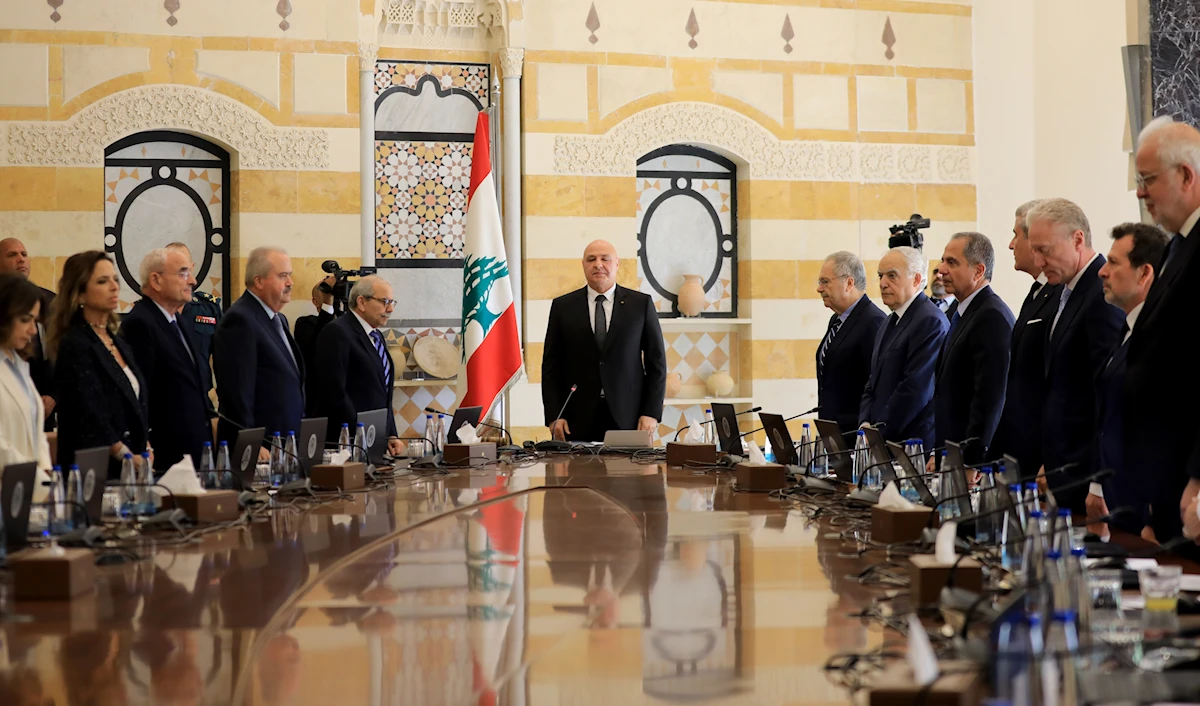
Lebanese citizens breathed a sigh of relief after last Friday’s cabinet session. Many had expected a major security explosion, while others expected the army’s plan to trigger a confrontation with the Resistance and its base. Events unfolded differently. Yet the file has not been shelved, as it remains in the grip of powers beyond Lebanon’s borders.
The Resistance stands alone at the center of the disarmament battle. Its officials have said in public what they repeated in private: the arms will not be surrendered. On the contrary, the reasons to hold on are stronger than ever. The Resistance maintained intensive lines of communication with state institutions to clarify its stance. It presented its vision to Army Commander General Rodolphe Haykal and other officers, warning of the dangers of dragging the army into a clash with the Resistance and its people.
The stance of the Resistance remained firm and explicit, which showed in Secretary-General Sheikh Naim Qassem’s addresses. His statements aimed to eliminate any ambiguity, as President Joseph Aoun and Prime Minister Nawaf Salam sought to interpret matters in vague terms while quietly laying the ground for their catastrophic decisions in early August.
Speaker Nabih Berri has also taken a more candid stance. His view is now shaped by the fate of the Shia community in the midst of the storms sweeping the region. For the first time, he appears to fully grasp what his ally Walid Jumblatt means by the “anxieties of a small community”. He now leans toward Jumblatt’s doctrine of precaution: protecting existence, representation, and interests against existential threats. Yet Berri is no tribal chief. He knows he has powerful partners when it comes to the sect’s destiny, yet he continually seeks reassurance about the Resistance’s abilities and capacity to face Israel, particularly after the scale of the latest Israeli aggression. This explains Berri’s interest in Iran’s position.
That was the main purpose of Iranian National Security Adviser Ali Larijani’s visit to Beirut last month. He carried a private message from Supreme Leader Ali Khamenei to Berri, affirming Iran’s full support for Hezbollah, its new leadership, and its new secretary-general just as it had stood by the late martyr Sayyed Hassan Nasrallah. The Resistance’s stance, Iran’s explicit backing, and the evolving realities in Lebanon, Syria, and the region prompted Berri to take a more assertive position this time.
This shift left both Aoun and Salam wondering whether Berri’s was maneuvering or had truly changed course. To them, Berri had been a partner in shaping the broader understanding with the US, and they believed his negotiations with US envoy Tom Barrack mirrored their own. Berri tried to reach common ground with Aoun, though not with Salam, whom he distrusts. But before Friday’s session, he felt compelled to express his anger at what was unfolding. His declared position carried a covert message to both men: he is still capable of helping them escape the trap.
“The Lebanese Army is not an institution that submits to political authority in the conventional sense of other states.”
On the opposite front stand numerous actors eager to eliminate the Resistance as an idea, a party, and a military force. Yet they lack the power to take decisive steps. Their endeavors remain limited to loud voices and appeals for US intervention. When Saudi Arabia pressed directly on the prime minister and most Sunni leaders, some officials in Beirut believed the US would in turn pressure the army command.
This is why today’s talk of “disappointment” with the army’s position only betrays ignorance of the institution’s real place in the ongoing conflict. The recent developments should have clarified, especially for President Aoun, that the Lebanese Army is not an institution that submits to political authority in the conventional sense of other states. Even when its leadership reaffirms commitment to government decisions, that does not mean it will execute every order. This has been the army’s practice since the Taif Accord.
It is ironic that many of those who helped draft the accord ignore one of its key constitutional changes: stripping both the president and prime minister of direct authority over the army, and turning it into an institution with a high degree of autonomy. That autonomy shields it from being used to enforce political decisions that pit one faction against another. When the army informed Lebanese officials and foreign parties that it was not ready to carry out the mission of disarming the Resistance, it was not maneuvering or shirking responsibility. It was openly declaring a political position grounded in field realities and in the army’s actual capacities – whether in manpower, equipment, or financial and logistical means. General Haykal stated this explicitly in his intervention during the cabinet session.
In practice, Friday’s session returned matters to the earlier standoff, leaving Washington to rethink its initiative toward Lebanon. Those familiar with Barrack’s efforts said his latest visit to Beirut ended in frustration. He failed to win even the smallest concession from Netanyahu, and back in Washington he faced strong pressure from officials close to the Zionist lobby who denied him the chance to defend his own position, particularly regarding his meeting with Berri.
Currently, Washington does not see itself in a position to compel Israel into taking steps that would help the Lebanese government implement its plan. That has alarmed Lebanese parties that pinned hopes on disarmament. They now find themselves trapped: on one side, an army warning against reckless adventures; on the other, US and Saudi patrons unable to extract concessions from Israel.
All of this brings us back to the fundamental question: if disarmament is such a pressing demand for Israel, the US, and Saudi Arabia, is Lebanon facing another round of suffocating political pressures, or another wave of Israeli madness?
This article was first published in Al-Akhbar.



